
On November 2, 2026, as tensions between Manila and Beijing continued over the People’s Republic of China (PRC)’s increasingly assertive activities in the West Philippine Sea, 23 Philippine business and sectoral organizations issued a joint statement calling for de-escalation between the Philippines and the PRC. The groups warned that deteriorating bilateral relations could jeopardize trade, investment, and economic cooperation with the PRC.
The statement illustrates how the Chinese Communist Party’s (CCP) long-term united front strategy can translate decades of relationship-building into political influence at critical moments.
Beijing has spent decades cultivating relationships with influential organizations and individuals across Philippine society. Through political appointments, institutional exchanges, business partnerships, and sustained engagement with local elites, the CCP has developed an extensive network of relationships around the world that can be activated to advance its political objectives. The November statement, followed by its rapid amplification in Chinese media, offers a glimpse into how this infrastructure of influence operates.
Building a network for long-term engagement
United front work is a central pillar of the CCP’s strategy for expanding its political influence. The Party cultivates relationships with influential individuals and organizations, drawing them into institutional networks that can help shape political and public opinion.
Overseas, this work is carried out through an interconnected system of Party-state institutions, including the United Front Work Department, the Chinese People’s Political Consultative Conference (CPPCC), and organizations involved in overseas Chinese affairs.
The CCP’s approach emphasizes sustained relationship-building. Business delegations, conferences, honorary appointments, cultural exchanges, and institutional partnerships create repeated opportunities for engagement. Over time, these activities establish personal relationships, organizational dependencies, and channels of communication.
Business associations are particularly valuable because they connect political leaders, corporate executives, and sectoral organizations. Their established positions within Philippine society give their messages domestic credibility and access to policymakers.
FFCCCII: Decades inside Beijing’s outreach network
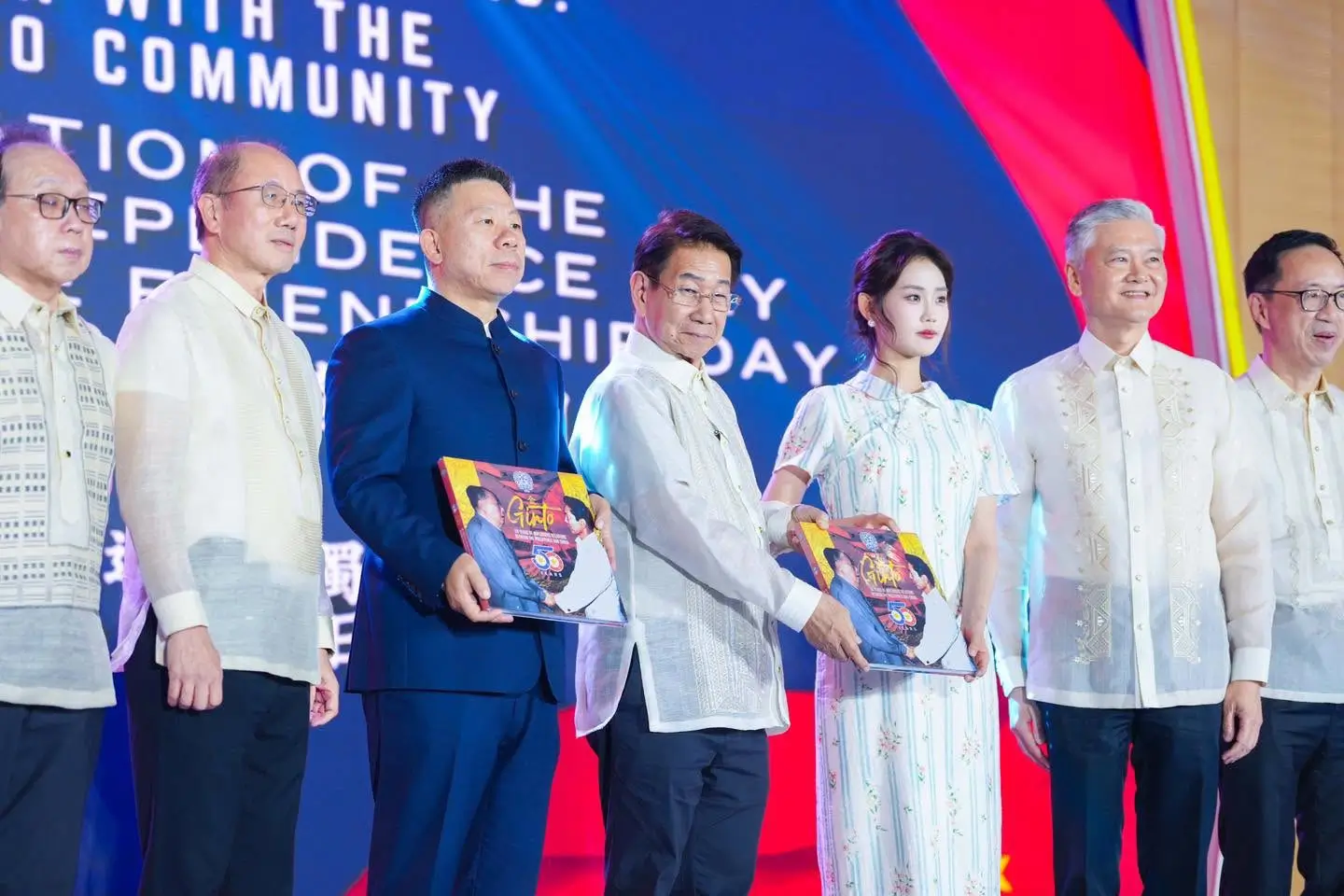
Among the 23 signatories, the Federation of Filipino-Chinese Chambers of Commerce and Industry, Inc. (FFCCCII) is a particularly important organization within Beijing’s longstanding outreach to the Philippines. Prior to the statement, on October 24, FFCCCII President Victor Lim (林荣辉), who attended the Conference for Friendship of Overseas Chinese Associations in July hosted by the united front agency Overseas Chinese Affairs Office (OCAO), publicly urged the Philippine government and the Chinese embassy to resolve their differences through dialogue rather than public exchanges on social media, citing the economic consequences of escalating tensions. The 23-group statement issued on November 2 subsequently echoed these concerns.
Founded in 1954, FFCCCII has developed extensive relationships with Philippine political leaders, business elites, and the Filipino-Chinese community. These domestic connections give the organization considerable reach within Philippine society.
In 1994, an FFCCCII delegation led by then-president Jimmy T. Tang (董尚真) visited the PRC at the invitation of the China Overseas Exchange Association (COEA) and the China Council for the Promotion of International Trade (CCPIT). The delegation was received by then-Chinese leader Jiang Zemin. COEA operated under the State Council’s Overseas Chinese Affairs Office, whose responsibilities were subsequently incorporated into the CCP’s United Front Work Department during the 2017 institutional restructuring.
FFCCCII has since had close connections with the united front system. Former FFCCCII president Zeng Tiefeng (曾铁锋) attended the national CPPCC session in 2003 as an overseas delegate. Other senior figures, including John K. Tan (陈本显) in 2009, Tan Ching (庄前进) in 2012, and Angel Ngu (张昭和) in 2016, also attended CPPCC sessions as overseas delegates. Multiple honorary presidents and presidents of the organization have served as COEA standing council members, council members, and advisors.
These longstanding institutional relationships have connected influential Filipino-Chinese business leaders to Beijing’s political outreach system across generations, providing the CCP with enduring channels of engagement in Philippine society.
Extending the network across Philippine society
The CCP’s relationship-building efforts extend well beyond Filipino-Chinese organizations. Several other signatories to the November statement have maintained contacts with PRC diplomatic officials, government-affiliated trade organizations, and business networks.
In March 2026, Chinese Ambassador Jing Quan addressed a meeting hosted by the Foundation for Economic Freedom, another signatory. In the same month, the Philippine Young Entrepreneurs Association (PYEA) met with representatives of the Young Entrepreneurs Committee of the Guangdong General Chamber of Commerce in Guangzhou, in a meeting facilitated by the Philippine Consulate General.
In September 2026, the Philippine Chamber of Commerce and Industry (PCCI) signed a memorandum of understanding with the CCPIT’s Hunan branch. CCPIT serves the united front function for the Party’s economic system.
These activities demonstrate the breadth of Beijing’s engagement across Philippine economic and professional institutions. Through exchanges and institutional partnerships, PRC officials and organizations cultivate relationships with local actors who possess influence within different sectors of Philippine society. As these relationships accumulate, they create overlapping networks that can amplify messages aligned with Beijing’s interests across multiple constituencies.
From network mobilization to narrative amplification
The November statement illustrates how Beijing’s longstanding influence networks can serve its political objectives through two reinforcing stages: mobilization and narrative amplification.
First, the 23 “Philippine organizations” collectively called for de-escalation, emphasizing the economic costs of deteriorating relations with China. Their message aligned with Beijing’s preferred framing of tensions in the West Philippine Sea, lending the argument domestic credibility through organizations representing influential sectors of Philippine society.
Chinese media then quickly amplified the statement and recast it as evidence of growing domestic opposition to the Marcos administration’s China policy. On November 4, the Party-affiliated Global Times portrayed the appeal as evidence that mainstream Philippine public opinion opposed confrontation with China. The report also criticized Defense Secretary Gilberto Teodoro and Philippine Coast Guard spokesperson Jay Tarriela, casting Philippine officials as responsible for escalating bilateral tensions. A November 5 article carried by China.com went further, describing the statement as 23 organizations pressuring the Marcos administration and declaring that its “anti-China script” had been torn apart from within. An article published on Phoenix New Media’s platform linked the statement to the November 3 phone call between Chinese Foreign Minister Wang Yi and Philippine Foreign Secretary Theresa Lazaro, suggesting that pressure from Philippine business groups had prompted Manila to contact Beijing.
The coalition subsequently reinforced its message as diplomatic developments moved in the direction it had advocated. Following the November 3 phone call, 20 of the original 23 organizations issued another joint statement commending the DFA’s engagement with Beijing and supporting its pursuit of “sustained dialogue over confrontation.” On November 7, the DFA publicly welcomed the statement. This marked a shift from urging de-escalation to publicly praising diplomatic steps consistent with the coalition’s earlier demands.
A reusable infrastructure of influence
The statements show the value of the CCP’s decades-long investment in cultivating relationships across Philippine society. Organizations cultivated through business exchanges, political appointments, and institutional partnerships can provide domestic voices for narratives aligned with Beijing’s interests. PRC’s media apparatus can then amplify these messages, presenting them as evidence of broader Philippine public opinion and increasing their political impact.
This infrastructure provides Beijing with a mechanism that can be used repeatedly across different political issues. The same network can be drawn upon during future disputes over Taiwan, Philippine security cooperation with the United States, Chinese investments, or other issues central to the CCP’s strategic priorities.
For the Philippines, understanding these longstanding networks is essential to assessing how the CCP seeks to influence domestic debates and decision-making over foreign policy, economic policy, and national security.