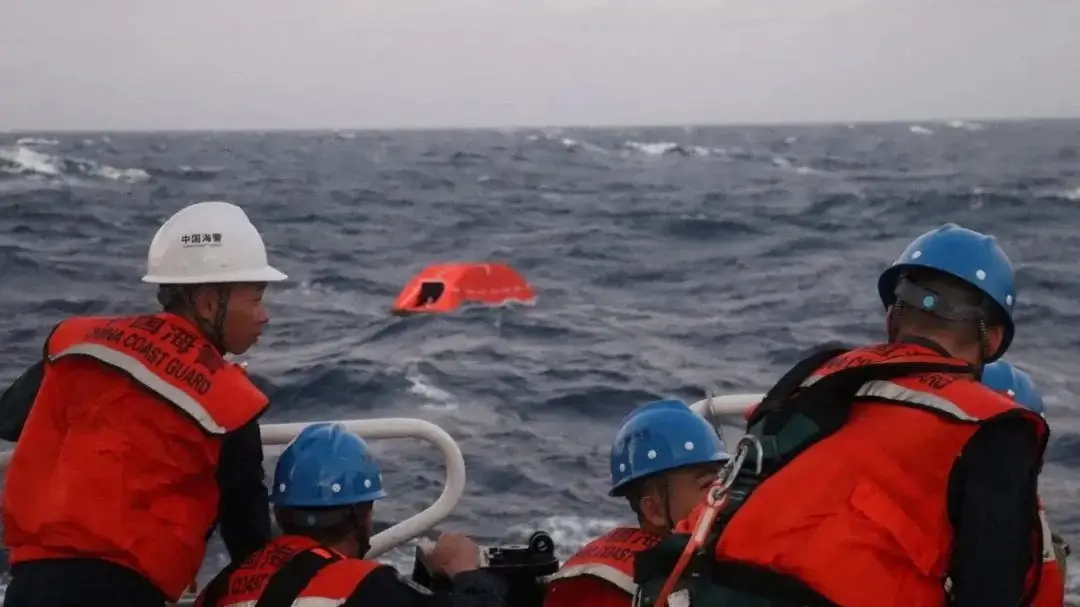

On 23 January 2026, the Singapore-flagged bulk carrier Devon Bay – carrying 21 Filipino seafarers – capsized about 55 nautical miles northwest of Scarborough Shoal. These are waters better known for confrontation than cooperation; but the immediate question was not sovereignty. Twenty-one seafarers were in danger.
The China Coast Guard, alerted through the Hong Kong Maritime Rescue Coordination Center, recovered 17 crew members, 15 of whom survived. The Philippine Coast Guard deployed two vessels and an aircraft, conducting largely separate search-and-rescue operations. On 25 January, the survivors and the remains of the two who passed were handed over to Philippine authorities at sea. Four seafarers remained missing when the search concluded on 1 February.
It was a tragedy for the families. It was also a reminder that maritime authorities can discharge humanitarian responsibilities without requiring to first settle the disputes between them. As then Commodore Jay Tarriela of the Philippine Coast Guard put it on 24 January, “This is the proper role of a coast guard – saving lives at sea.”
Nicholas Lim and Chong De Xian have already made the case for a standing search-and-rescue procedure between the two coast guards in RSIS Commentary CO26024. This piece builds on their argument and asks a further question: how can necessary cooperation remain dependable when normal bilateral arrangements are disrupted?
The test is not good weather
Cooperation that works only when politics allows it is not dependable. Devon Bay shows what is possible. It does not show what will happen when relations deteriorate. The China-Philippines Joint Coast Guard Committee, established in 2016 with a hotline, was reported to be suspended as of February 2026. Existing channels are, in other words, as exposed to political weather as the relationships they serve.
That matters because disagreement here is not a temporary failure of governance. It is the condition governance has to work within. Competing claims, overlapping legal authorities and increasingly assertive activity at sea will persist. Practical cooperation should neither obscure these differences nor excuse them. A successful rescue cannot compensate for unsafe conduct elsewhere, and humanitarian acts should not be used to validate contested claims. Both points need stating plainly.
The duty to rescue, though, does not wait for those questions to be resolved. Article 98 of UNCLOS requires assistance to persons in distress and cooperation in maintaining search-and-rescue services, while the International Convention on Maritime Search and Rescue provides a framework for coordination. These obligations are not conditional on political agreement.
Yet obligations do not rescue anyone. Information has to reach the right authority. Assets have to be identified, tasked and positioned. Survivors have to be transferred, often at sea, between authorities whose political instructions may differ. In an earlier Lowy Interpreter commentary, Lowell Bautista and I argued that regional institutions often have the architecture, while the plumbing connecting information, authority and action remains underdeveloped. The same holds here. Governance is the point at which information becomes action, and that point is where cooperation is most likely to fail.
Why professional goodwill is not enough
In an East Asia Forum commentary on human networks and maritime security, Tita Sanglee and I argued that professional relationships help institutions coordinate when formal processes are slow. That is true in a crisis. But relationships are fragile – personnel rotate, instructions change, and political tension can narrow what professionals are allowed to do. Goodwill between individual officers may help on the night. It cannot be the only thing that does.
The design challenge is therefore to build arrangements that survive limited trust. They need to work when the hotline is silent, when the officers who knew each other have moved on to other appointments, and when nobody has time to obtain fresh political guidance.
There is an important counterargument. The Devon Bay response succeeded in rescuing 15 survivors and completing a coordinated transfer despite the suspension of the Joint Coast Guard Committee. Perhaps existing arrangements already provide sufficient flexibility, without additional bilateral procedures.
That possibility should not be dismissed. But one successful operation demonstrates feasibility, not reliability. It tells us relatively little about whether the same arrangements would work with disrupted communications, fewer available assets, or greater political sensitivity. The question is not simply whether cooperation has occurred, but whether the means to achieve it can withstand less favorable circumstances.
Making cooperation work when normal channels fail
One recommendation would be to develop a one-page technical handover protocol, authorized through existing national channels, maintained by operational authorities and tested annually. It would comprise of four parts.
First, a minimum data set for every handover at sea: numbers and medical condition of survivors, handling of remains, position and time window, receiving platform, and communication frequencies. A standard format means these details need not be negotiated afresh each time.
Second, standing contact points identified by role, not by name, in each coast guard’s operations center and the relevant rescue coordination centers. Roles survive rotations. Names do not.
Third, a standard without-prejudice statement: the handover implies no position on jurisdiction, maritime entitlements or sovereignty. Political approval for this wording would be sought in advance, rather than improvised in the hours after a capsize.
Fourth, a fallback information pathway for when bilateral communication is unavailable. In the Devon Bay case, Singapore’s Maritime and Port Authority coordinated as flag State, while the Information Fusion Center used its Voluntary Community Reporting scheme to seek sightings from merchant ships.
Depending on the circumstances, a relevant rescue coordination center, flag-state authority or regional information-sharing arrangement could help relay urgent distress information when direct bilateral communication is disrupted. Such relays would supplement, rather than replace, the responsible rescue authorities. Their effectiveness would depend on established contacts, agreed procedures and the willingness of the relevant authorities to act.
The protocol should then be rehearsed in a closed tabletop exercise that assumes difficult conditions: a night-time capsize, a suspended hotline, new duty officers and conflicting public statements. The measure of success should be practical, such as the time from distress alert to an agreed handover plan, rather than the tone of the communiqué. Where the arrangements fail, the failures should be documented and addressed.
None of this needs a new institution, a political breakthrough or any change in legal positions. It does need operational authorities to maintain procedures within their existing mandates, and political leaders to authorize the necessary scope for humanitarian coordination.
What this does not do
The protocol will not resolve sovereignty disputes. Nor will it address harassment of fishing vessels, collisions, or coercive conduct at sea. Treating humanitarian cooperation as proof that the wider relationship is healthy would be a mistake. Its value is narrower: reducing the likelihood that political disagreement becomes the reason an avoidable delay occurs when lives are at risk.
Cooperation need not mean concession. Professional responsibility need not imply political alignment.
In disputed times, the measure of maritime cooperation is not whether states agree. It is whether, on the night the call comes, the arrangements still work.