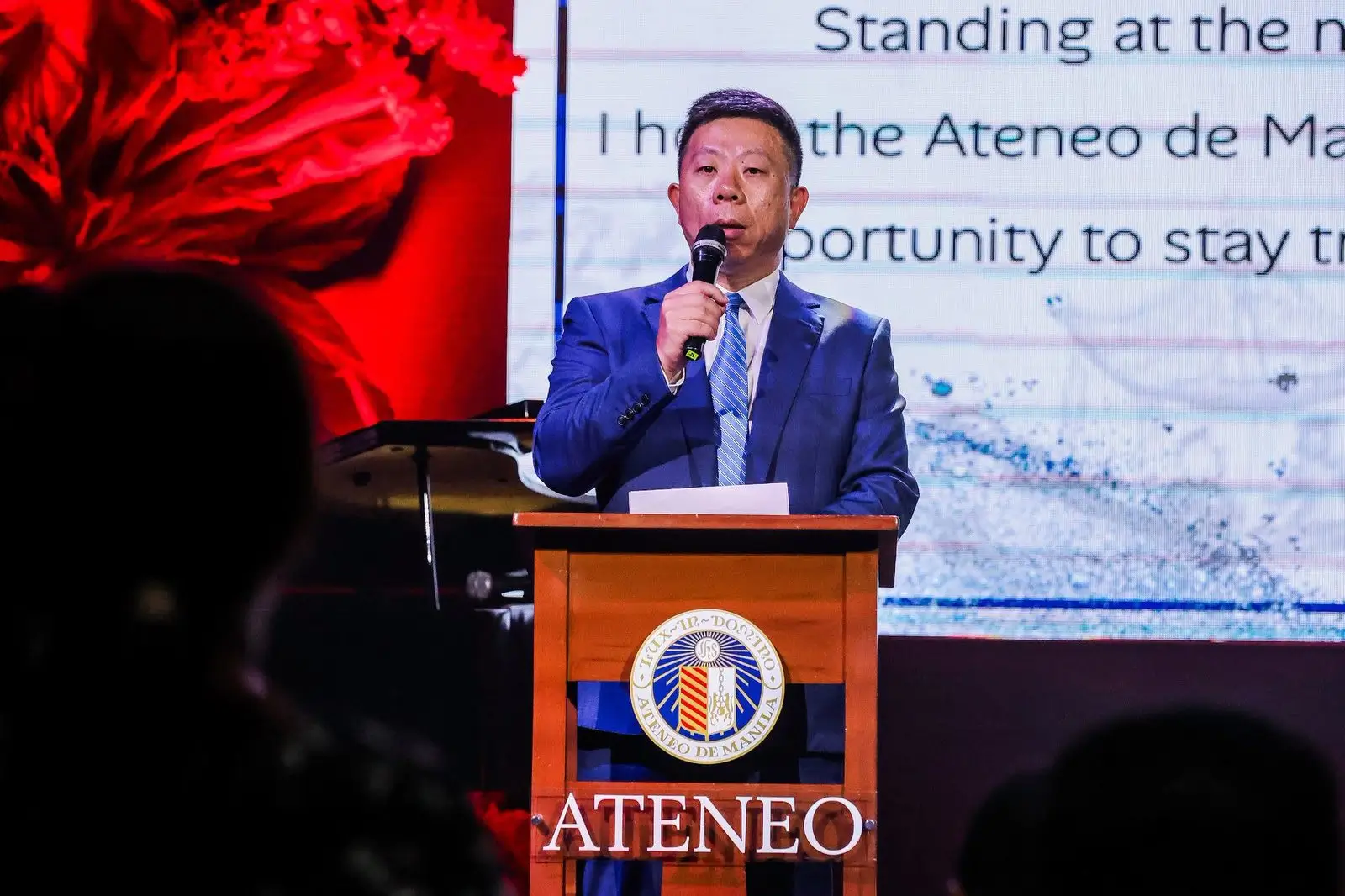

On October 15, China’s ambassador to the Philippines, Jing Quan, told Filipino reporters that China “may easily win” if it chose force. “But no, we will not choose force and we love peace,” he said, while at the same time pointing ominously to “Ukraine, Gaza and even Venezuela.” That’s why Filipinos should “feel fortunate that you have a neighbor like China,” he said soothingly.
Veiled threat or not, Jing’s words were intended to remind Filipinos of China’s power, offer its restraint as a gift and leave war as the sole alternative to accepting Beijing’s terms. More than a poor choice of words, they represented a tactic in a larger campaign of conquest.
That campaign is called “pacification,” and its object is to subdue organized resistance to China’s maritime occupation of the West Philippine Sea.
Why “pacification”?
Pacification is an imperial word. In 1573, Spain’s Philip II ordered that new expeditions no longer be called conquests but pacifications, carried out “with all the peace and charity that we desire.” Spain described its conquest of the Philippines the same way.
The word names a political logic: turning gains secured by force into authority the conquered must accept. Beijing seeks to accomplish this through a combination of gray-zone warfare at sea and political warfare on land, targeting Filipino minds as much as Philippine ships.
Filipinos have heard this before, and from my own country in fact! In 1898, U.S. President William McKinley proclaimed that Americans came “not as invaders or conquerors, but as friends.” Those who cooperated “by honest submission” would receive “the reward of its support and protection.” Those less accommodating would be “brought within the lawful rule we have assumed, with firmness if need be.”
While China’s maritime imperialism doesn’t involve building a colonial government in Manila, the offered bargain is familiar: accept our conquest as a fait accompli and its coercive authority as benevolence.
Pacification campaigns follow a pattern. Remind people that you are strong and can hurt them if you are “provoked,” and then present your “restraint” as a gift to be gratefully accepted. Brand those who resist as “troublemakers” stirred up by outside “agitators.” Reward those who cooperate as far-sighted beneficiaries of the peace and prosperity that come with the new order.
A pacified population need not love the imperial power, but only believe that continued resistance costs too much and changes too little.
Beijing’s “sea of peace”
Xi Jinping has called for making the South China Sea “a sea of peace, friendship and cooperation,” and Xinhua’s think tank dutifully turned that slogan into a report. In its telling, the region was “free of such conflicts” until “external forces” turned it into a “source of issues.”
That framing recasts China’s force-backed expansionism as restrained “law enforcement” set against “provocations.” It also presents open hostilities as the only alternative, with Beijing’s restraint all that stands in the way of the horrors of the war China “may easily win.”
Critics of the imposed peace must then be warmongers. A 2025 Global Times commentary complained that the sea had been “held hostage” by “war narratives,” while the embassy accused Coast Guard spokesman Jay Tarriela of promoting “precisely the outcome that should be avoided most: a war between China and the Philippines.”
Of course this is a false choice: refusing to capitulate isn’t choosing war, as is evident from the Philippines’ choice to resist by nonviolent means. The only armed conflict under discussion is that now routinely threatened by Beijing.
Beijing’s “sea of peace” works rhetorically like McKinley’s “benevolent assimilation” did in 1898: Philippine waters will be “at peace” when Filipinos stop resisting.
Pacification’s players and poses
Local sympathizers. Empires co-opt and reward indigenous voices because their messages sound more acceptable from a neighbor than a foreign embassy. Former national security adviser Clarita Carlos helpfully called Tarriela a “troublemaker” and told him to “shut up.” Herman Tiu Laurel, whose Asian Century Philippines Strategic Studies Institute routinely carries Beijing’s water, says Defense Secretary Gilberto Teodoro’s “anti-China diatribes” endanger the economy. Both won awards presented jointly by the Manila-based Association for Philippines-China Understanding and the Chinese embassy, which also funded the cash payouts that accompanied the prizes.
Troublemakers. Carlos’ characterization of Tarriela did not originate in Manila. Foreign Minister Wang Yi asserted that “certain forces within the Philippines, particularly those from the military and law enforcement, deliberately stir up trouble.” After Teodoro criticized China in June, the foreign ministry urged Manila to “strictly restrain the words and actions of its officials” instead of allowing “a handful of grandstanding buffoons” to sabotage relations.
Outside agitators. Wang adds that these troublemakers “act on the instructions of external forces,” which reflects tried-and-true imperial rhetoric going back centuries, though you don’t have to look that far back to find it. Beijing repeatedly blamed Hong Kong’s 2019 protests on “foreign forces” before finally crushing them. In fact, I’ve been cast in this “black hand” role myself. The charge denies the local resistance any agency or legitimate grievance by turning citizens into instruments of a foreign agenda.
Restraint as a gift. After China’s coast guard held up an October 8 medical evacuation from Second Thomas (Ayungin) Shoal, Beijing insisted it had given Manila “permission” to do so. When the same outpost was resupplied on October 21, Beijing claimed the delivery came “with approval from the Chinese side.” The intent is to present China’s conquest as legitimate and inevitable, because when approval is necessary, noninterference becomes a favor.
The long resistance
The current Philippine reality is this: an expansionist, imperial power has rejected peaceful arbitration properly convened under international law; has ignored its own signed agreement barring the “threat or use of force”; has occupied vast and growing swaths of the West Philippine Sea; and is now waging an aggressive political war to convince Filipinos to accept the outcome as settled.
Resistance to occupation is rarely quick, and often spans generations. Ships, allies and law will all play their part, but nothing can replace a resilient nation committed to upholding its sovereign rights and rejecting Beijing’s coercive terms. Naming Beijing’s peace as the demand for capitulation it actually is won’t end the occupation on its own, but it’s indispensable for building that resilience.
When Moscow annexed Estonia, Latvia and Lithuania in 1940, it falsely claimed all three had asked to join the Soviet Union voluntarily. For half a century, their prewar legations’ diplomats in Washington kept representing their occupied states. In 1991, those same states restored their independence. Refusing the occupier’s account kept their legitimate claim alive until the moment came.
Today, Xi Jinping calls for a “sea of peace,” but what he offers is a “sea of pacification.” I firmly believe that those who reject this bargain aren’t “troublemakers” who should “shut up,” but patriots with the courage to resist.
Beijing may not remember them as such, but history surely will.