
China has arguably never been more powerful, having accumulated economic, military, technological and diplomatic capabilities that bear little resemblance to those of the People’s Republic of China (PRC) proclaimed in 1949. It is the world’s second-largest economy, a nuclear power, a permanent member of the UN Security Council and possesses the world’s largest navy by number of vessels. Yet greater power has not necessarily produced greater strategic reassurance.
Instead, Beijing’s conception of security appears to have continuously expanded. From political, military and territorial security under Mao Zedong, its scope progressively expanded to encompass sixteen distinct dimensions of national security under Xi Jinping, ranging from economic and technological security to cyberspace, outer space, the polar regions, the deep sea and overseas interests. The incorporation of issues as diverse as territorial integrity, Taiwan, political stability, maritime claims, foreign military presence, technological dependence and external interference into this increasingly broad understanding of national security has contributed to turning the entire First Island Chain into a continuous arc of crises and tensions.
This raises a fundamental question: why has the extraordinary growth of Chinese power failed to produce greater strategic reassurance? China’s current behavior cannot be understood through the balance of power alone, as its roots also lie in the profound insecurities surrounding the creation of the PRC and the progressive conflation of the security of China with that of its political system.
The insecure superpower
This paradox is particularly visible along China’s periphery, where Beijing faces disputes or serious strategic tensions with India, Japan, Taiwan and several Southeast Asian states. Although legally and historically different, together they form an arc of friction around China, while the First Island Chain has become the theater of increasingly persistent interactions involving Chinese military, paramilitary and civilian actors.
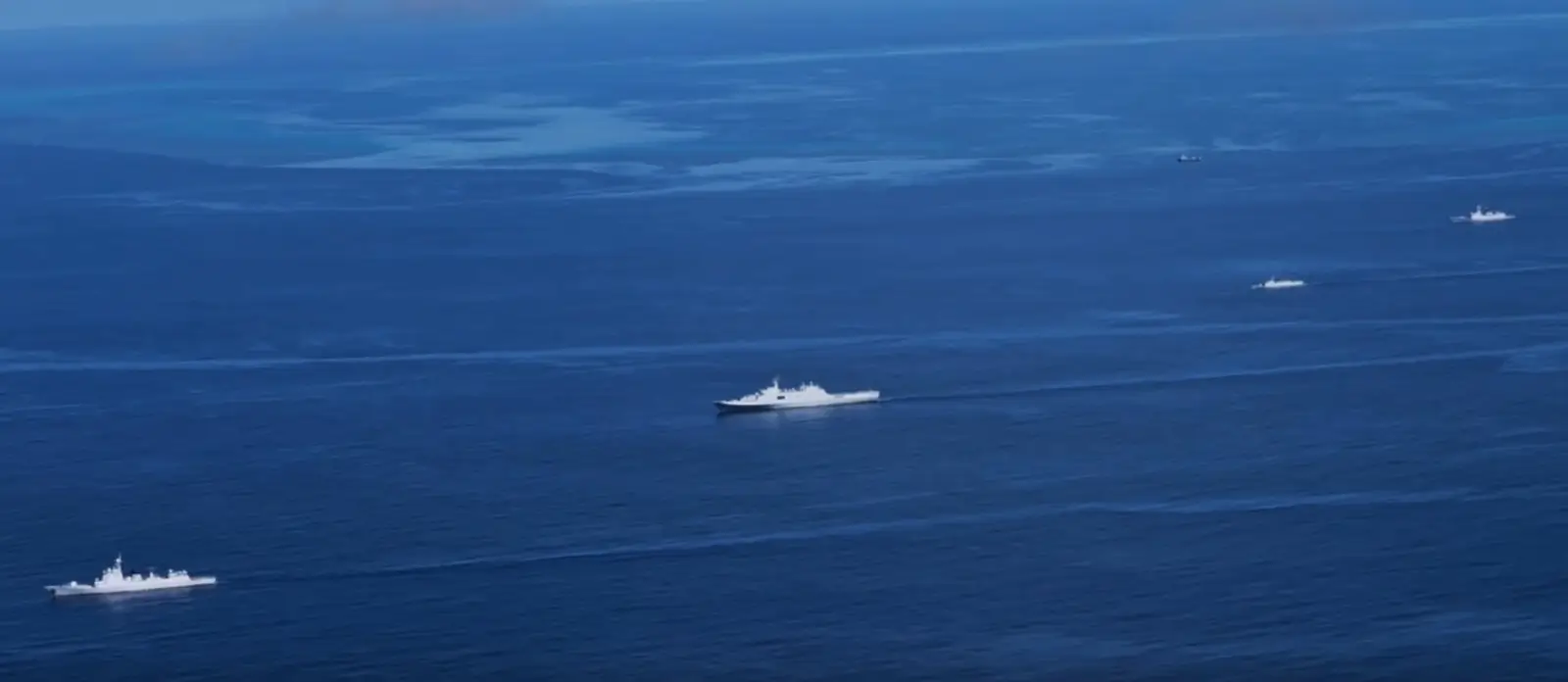
The instruments employed have multiplied accordingly. The People’s Liberation Army Navy is complemented by the world’s largest coast guard, an extensive maritime militia, fishing fleets, research vessels, civilian auxiliaries and drones, alongside economic, informational, legal and administrative instruments. Rather than replacing older means, China has accumulated new ones, combining area denial, hybrid warfare and grey-zone tactics into an increasingly comprehensive toolbox.
This evolution is also visible in the incidents themselves. My database of more than 850 interactions along the First Island Chain documents their increasing persistence, geographical distribution and diversity. Blocking manuevers, ramming, water cannons and lasers coexist with electronic warfare, radar illumination, jamming and spoofing, illustrating how growing capabilities have enabled increasingly sustained and diversified pressure against China’s neighbors.
The Philippines offers a particularly revealing illustration. Despite the enormous material asymmetry between the two countries, Scarborough Shoal, Second Thomas Shoal, Sabina Shoal and other locations have become scenes of repeated confrontations, while comparable patterns can be observed elsewhere along China’s maritime periphery. The paradox is striking despite possessing unprecedented power, China devotes increasing resources to securing itself against neighbors whose individual capabilities remain considerably inferior to its own.
The roots of China’s strategic anxiety
Understanding this contradiction requires returning to 1949, when the PRC emerged from circumstances that gave its leadership genuine reasons for insecurity. Even its military triumph contained a paradox: Nationalist forces had borne the brunt of China’s conventional fighting against Japan, while Soviet intervention in Manchuria fundamentally altered the strategic situation after 1945. Communist forces subsequently benefited from strategic depth and access to Japanese weaponry, although the extent of direct Soviet assistance remains debated. The regime was victorious, but the foundations of its victory were more complex than its subsequent narrative suggested.
A second paradox concerned political control. The Communist Party had conquered the state without yet possessing the degree of institutional control it exercises today, while the new political order retained a United Front incorporating eight other legally recognized parties and various political constituencies. Victory in the civil war had therefore given the Party control of the state without immediately providing the political and institutional consolidation that would characterize subsequent decades.
A third paradox concerned domestic legitimacy, as territorial control did not automatically translate into political acceptance across a country emerging from decades of fragmentation, invasion and civil war. The new authorities had to transform revolutionary victory into durable legitimacy, progressively connecting the preservation of Communist rule with that of the state and making national security, political stability and regime security increasingly difficult to separate.
Finally, controlling mainland China did not immediately mean representing China internationally, as the Republic of China in Taiwan retained considerable diplomatic recognition and China’s UN seat until 1971. Military legitimacy, political consolidation, domestic legitimacy and international recognition therefore constituted genuine sources of insecurity in 1949. The deeper paradox is that the PRC progressively overcame most of these vulnerabilities while continuing to broaden what it considered essential to its security.
When strategic anxiety becomes self-defeating
This expanding security perimeter comes at a cost, as Chinese actions generate distrust among precisely those neighbors Beijing would benefit from reassuring. Although Pew Research Center’s 2026 surveys indicate some improvement in China’s global image, attitudes are markedly different in several countries directly exposed to Chinese power: 76% of Filipinos identify China as their country’s greatest threat and 86% express concern about territorial disputes involving China, while similarly strong security concerns are visible in Japan and Australia.
Pressure is also turning former competitors into partners. Vietnam and the Philippines maintain overlapping claims in the Spratly Islands and historically competed for control of maritime features, yet their perception of a more serious common challenge from China has progressively encouraged them to manage their differences and cooperate. As I documented in The Conversation in 2024, this rapprochement has developed through coast-guard cooperation, hotlines, information sharing, confidence-building measures and naval exchanges. In June 2026, the two countries elevated their relationship to an Enhanced Strategic Partnership.
The consequences extend beyond this bilateral relationship. Pressure from Beijing gives neighboring states additional incentives to strengthen their armed forces, deepen security relations with the United States and other partners, and diversify economic and diplomatic relationships. It can simultaneously increase the value of managing their own disputes, while international law—and UNCLOS in particular—provides smaller states with a common framework for cooperation and a means of mitigating some disadvantages created by their material asymmetry with China.
Chinese strategic anxiety may consequently become self-defeating. Beijing seeks greater strategic depth, fewer vulnerabilities and reduced exposure to outside powers, yet sustained pressure encourages neighboring states to strengthen their defenses, cooperate with one another and seek additional external partners. Beijing can then interpret these responses as evidence of containment, producing a self-reinforcing cycle in which strategic anxiety encourages coercion, coercion generates distrust and balancing, and balancing reinforces the perceptions of encirclement that encouraged coercion in the first place.
Conclusion
The contrast between 1949 and today captures the central paradox. The Communist leadership initially confronted genuine problems of military credibility, political consolidation, domestic legitimacy and international recognition, whereas contemporary China has overcome most of those vulnerabilities and accumulated capabilities its founders could scarcely have imagined. Yet this unprecedented growth in power has been accompanied by an expansion, rather than contraction, of the geographical, political and strategic perimeter Beijing considers necessary to secure.
The pursuit of greater security may therefore itself become a source of insecurity. Pressure intended to consolidate Chinese claims and reduce foreign influence encourages neighboring countries to rearm, manage their differences, cooperate more closely and develop stronger external partnerships, potentially creating precisely the regional alignment Beijing seeks to prevent. China’s greatest strategic vulnerability may consequently no longer be a lack of power, but its difficulty in translating unprecedented power into reassurance—either for itself or for its neighbors.